
A brief history of st Luke's
You'd really be surprised at the number of people, including Formby residents who, when they come to St. Luke's, say that this is their first visit. So if you’ve never been, why not come along. Set in the pinewoods, the Church is a real gem and the Churchyard, through snowdrops and daffodils and primroses and bluebells in springtime, is beautiful as well as historic.
Historic because this is an ancient site. There is a 12th Century font from the original Formby Chapel as evidence for that. The Church before this one, known now as Formby Chapel, was destroyed in a sandstorm in 1739, a storm so bad that it obliterated all the boundary marks. Again we've got evidence for that, a new boundary marker dated 1746. Stone from that original church was used in the construction of St Peter’s a little further inland.
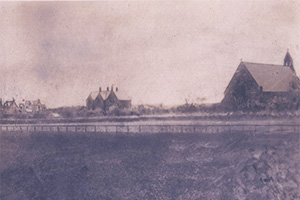
It was the coming of the railway, and the prospect of a growing seaside resort that led to the building of a new church. Miles Formby had the idea. He died, but his sister, Mary, and his brother, Richard, built the nave and porch and the Church was consecrated by the Bishop of Chester in 1855. A Daguerreotype photograph, circa 1860 shows the original building. The church now is in the edge of pinewoods that, we see from the picture, didn’t exist when the church was built. Also in the picture is the house belonging to members of the Formby family.
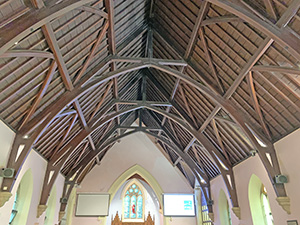
There was innovation in the construction of the church. The roof trusses, see the picture, are one of the first examples of the use of glue lamination. Glulam overcomes the size limitations of sawn timber.
The chancel and vestries were added by Richard's daughter Caroline in 1897 in memory of her father.
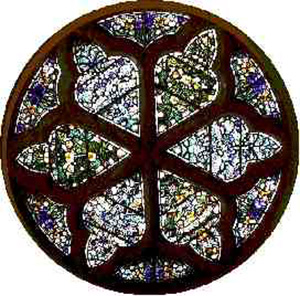
The church has beautiful stained glass - the Minnitt windows in the Chancel, the St Luke window in the west wall and above all the Rose Window (Pictured below), which depicts all the local flowers. All the inscriptions in the west wall windows are medical because Richard Formby was an eminent doctor and a pioneer of anaesthetics in the 1830's. St. Luke, if you remember, was a doctor. Then we've still got the original pews, numbered because people paid for a reserved seat in the old days. Not everything is old for we have a modern 3 manual electronic organ.
Memorials around the walls testify to the sacrifices made by village families and the Formby family in two World Wars. In the porch there's the gravestone of Richard Formby, armour bearer to Henry 4th, who died in 1407. He is buried in York Minster but Dr.Richard Formby provided a facsimile gravestone and was allowed to bring the original gravestone, damaged in a fire in 1840, to St. Luke's.
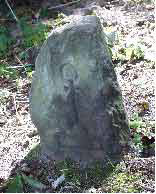
The Churchyard remained open after the storm. Our oldest grave dates from 1666, but the mysterious Godstone (see the picture below) could be much older than that. We have the Village Stock, and the old Village Cross. The wooden Cross had rotted so we replaced it as a Millennium Project, at the suggestion of pupils from St Luke's School. Percy French, the famous Irish entertainer and artist, is buried in St Luke's. We even boast the first street-light in Formby.
Most of this page was written by the late Allan Waplington. Allan concluding by saying “I hope I've whetted your appetite sufficiently for you to want to visit the Church. We are proud of its 150 plus years of service to our Lord. Don't miss it! It is a gem!”